
Emergency Air Duct Cleaning Near Me: What El Paso Homeowners Should Do First
If you just found standing water in the air handler closet or a rodent nest behind a return grille, calling a duct cleaning company is step three. Steps one and two decide whether cleaning fixes the problem or just chases it around the system. The first thirty minutes are the ones that count, and none of them involve a phone. Here’s how to triage a suspected duct emergency in El Paso before any equipment rolls up, and how to tell the real emergencies apart from the urgent ones.
What Counts as a Duct Emergency in El Paso?
A duct emergency is any event that has put contamination inside the ductwork or the air handler and is still actively spreading. Urgent-but-not-emergency problems can wait for the next opening. The distinction matters because it changes what you do in the next half hour.
Real emergencies in El Paso homes tend to fall into four buckets:
- Post-flood contamination. Water that reached the air handler, the plenum, or the duct runs leaves a moisture problem inside the system. Damp insulation and pooled water in a plenum create a breeding ground for mold very quickly, and desert heat speeds that up.
- Confirmed rodent intrusion. Droppings, shredded insulation, or a musky odor coming from the vents mean animals have been moving in the ductwork, and their waste is now in the airstream.
- Sewage backup near the air handler. A drain line or nearby plumbing failure that reaches the air handler is a contamination event, not just a plumbing one.
- Fire or smoke residue. Even a small kitchen fire can pull smoke through the returns and leave soot on duct walls, which keeps off-gassing long after the smoke clears.
What is not a duct emergency: a single dusty vent, a musty closet, a dryer that takes one cycle longer than usual, or a low-flow register on one side of the house. Those are worth fixing. They don’t need a scramble. When you sort the urgent from the emergency, you save money and you get better work done because the technician isn’t racing a spreading problem.
The First 30 Minutes: Triage Before You Call Anyone
Shut the system down first. Not to the fan setting, not to “auto” – off at the thermostat, and if the contamination is near the air handler, off at the breaker too. This is the step most homeowners skip, and it’s the one that decides how far the problem goes.
- Stop moving air. A running blower is a distribution engine. Every minute the system moves air after a flood, a rodent event, or a sewage backup, it pushes contaminated particles deeper into supply runs, across the coil, and into the rooms. Turn it off and leave it off.
- Isolate the source. Close return grilles in the affected zone if you can do it safely. If water is standing, shut the water off to the unit or call a plumber before you call us. If you smell gas at any point, leave the house and call your gas utility first.
- Document with photos. Photograph the standing water, the droppings, the soot line, the thermostat, and the air handler label with the model and serial number. Photos do two things: they help a technician assess scope before arriving, and they protect you if an insurer or landlord needs records.
- Map the affected side. Note whether the problem touches supply ducts, return ducts, or the air handler itself. Supply ducts carry air out to rooms. Return ducts pull air back and typically collect the most debris. The air handler is the central unit and the coil. Each is remediated differently, and knowing which is involved is the question a serious contractor will ask first.
Once those four steps are done, you’re in a position to make a clear call instead of a panicked one. If you’d rather not work through this alone, call (866) 942-6158. We answer 24/7. Fast dispatch from 7am to 7pm, Sunday through Friday.
Why Running the HVAC System Makes It Worse
A central air system is designed to move hundreds of cubic feet of air per minute through the whole house. That’s the point of it in El Paso, where summer heat keeps the system running most of the day. It’s also exactly why you want it silent after a contamination event.
If a rodent has been nesting in a return, its waste, hair, and shredded insulation are sitting on the duct floor. Turn the blower on and that material becomes airborne, spreads to the coil, and settles into supply runs feeding bedrooms and kitchens. Water damage is worse. A wet plenum with the blower running sprays moisture droplets through the trunk line and into the coil, which is the fastest way to turn a small leak into a mold problem across the whole system.
This is the reason our first instruction on any call is the same: keep the system off until a technician scopes the ductwork and confirms where the contamination stops. We bring Abatement Technologies air-filtration units to run on-site during the job because airborne dust during a cleanup is a real problem in a closed house. Capturing particles at the source is common practice for us and, honestly, basic courtesy.
One more thing: don’t run fans, portable air cleaners, or window units pulling outside air inward to “air out” the house. You’re just moving the same particles around.
What Emergency Duct Cleaning Can and Can’t Do
Duct cleaning removes physical debris from the ductwork and, where appropriate, applies EPA-registered sanitizers to the cleaned surfaces. It does not fix a moisture problem that’s still active, and it does not repair crushed or disconnected ductwork. Cleaning a wet system without finding the leak just means re-cleaning the same ducts later.
That sequence is why duct cleaning is almost never the first job on a contamination event. Here’s how the order usually looks:
- Fix the source first. Stop the leak, remove the animal, address the plumbing. Cleaning after the source is contained is effective. Cleaning before is temporary.
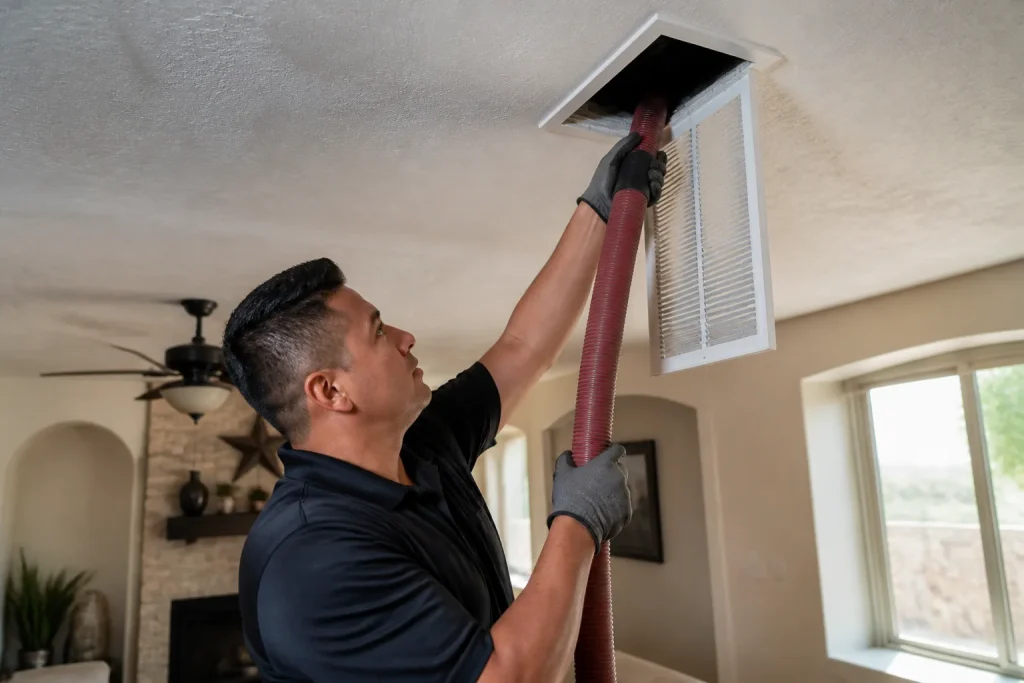
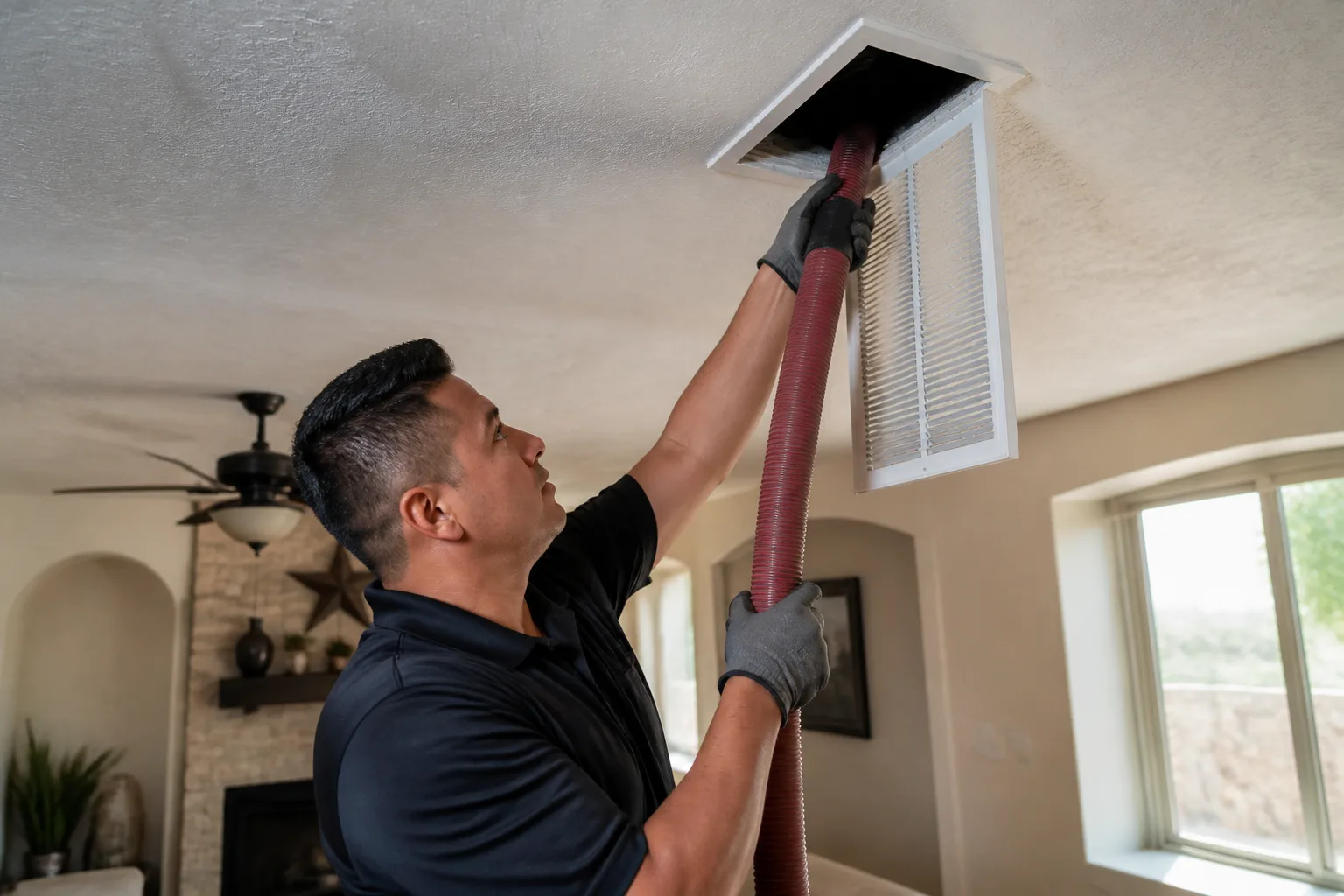
- Then clean the ductwork. A professional air duct cleaning visit uses a rotary-brush system, like Rotobrush, that scrubs the duct walls and pulls debris into a vacuum rather than stirring it. In our experience, a shop-vac and a brush on a broom handle doesn’t move what’s actually bonded to the duct liner.
- Then repair what’s found. Cracked seams, disconnected flex runs, or crushed duct sections get sealed or replaced so the cleaned system stays clean. We repair what we find, which is why we offer duct repair as its own service.
- Then sanitize if needed. A sanitizer applied to a clean, dry duct is a finishing step. Applied over wet debris, it’s not doing much.
So the honest answer to “can emergency duct cleaning fix this?” is: yes, once the source is contained. No, if the water is still coming in or the animal is still living in the attic.
What about a dryer that’s acting strange?
If your dryer is taking two cycles to dry a load or the vent smells hot, that’s a fire-risk warning, not a duct emergency – but it belongs on the call. A lint-impacted vent restricts airflow and lets heat build up. Dryer vent cleaning addresses the full vent run as a fire-prevention measure, which is how we treat it every time.
How to Vet a Duct Cleaner Fast When You’re Stressed
You’re searching at 10pm with a flashlight and a bad smell coming from a return grille. Ask three questions before you let anyone near the system. A real specialist will answer all three without hedging.
- What equipment do you use? The correct answer involves a purpose-built rotary-brush system and negative-pressure capture, not a portable vacuum and a promise. Professional equipment, not a shop-vac, is the baseline.
- How do you handle the source? If the answer is “we’ll just clean the ducts,” that’s a red flag on a flood or rodent call. A serious company asks what caused the problem and whether it’s still active.
- Can you repair what you find? A cleaning-only company will leave a disconnected flex run for someone else to fix, which means cleaning it twice. If they can’t seal or reconnect ductwork, ask who will.
Ask for their process in plain language and see whether it lines up with what you’ve read here. The El Paso climate amplifies dust, so questions about filtration products are worth asking too. We work with Aprilaire and Honeywell filtration, which means a technician can assess a whole-home filtration upgrade during the visit if that’s what your household needs. The right answer to your vetting questions should make sense before you spend a single dollar.
When to call a pro
Call us as soon as the source is contained and the system is off. If you’re unsure whether a problem is contamination or just dust, a scope visit settles it. Don’t wait for a smell to get worse or a musty closet to become a mold problem – by then the remediation cost is higher.
Related services in El Paso: air duct cleaning, dryer vent cleaning, and air duct repair are the three services we run. No add-ons that don’t belong.
The Bottom Line
- Shut the system off first. A running blower spreads contamination through every duct and the coil.
- Fix the source before you clean. Water has to stop, animals have to be removed, repairs happen first.
- Photograph everything and note whether supply, return, or the air handler is involved.
- Ask three questions of any company: equipment, source handling, repair capability.
- Cleaning a wet system without fixing the leak just doubles the work.
If you’re in El Paso and need help, Duct Cleaning El Paso offers free estimates – call (866) 942-6158. We answer 24/7. Fast dispatch from 7am to 7pm, Sunday through Friday. Our technicians have up to 10 years of experience and use Rotobrush and Nikro systems on every job, so you get a real method instead of a quick vacuum.
Frequently Asked Questions
Most duct cleaning jobs in El Paso fall in a typical range set by the size and condition of the system, not by a flat price. The written estimate you receive before work starts sets the final price, and it’s free. Call (866) 942-6158 for an exact quote.
No. Keep the system off at the thermostat and, if near the air handler, at the breaker until a technician scopes the ductwork. A running blower pushes contaminated particles deeper into supply runs and onto the coil, which makes the cleanup larger. Call (866) 942-6158 to get someone out to assess it.
A professional company should show you what they found and what they removed. We take before-and-after photos of your own ducts, so you see the change, not a claim. Call (866) 942-6158 to schedule a visit.
For most homes in El Paso, duct cleaning belongs on a multi-year schedule, not an annual one, and events like a flood, a rodent intrusion, or a fire override any schedule. If you’ve had a contamination event, clean now and reassess. Call (866) 942-6158 for a free estimate.
Written by the team at Duct Cleaning El Paso.
Need Air Duct Cleaning Help?
Call Duct Cleaning El Paso - licensed & insured, here with fast help in El Paso.
(866) 942-6158