
How to Choose the Right Air Duct Cleaning Company in El Paso
Any company can claim to use “professional equipment” and “proven methods.” The question is whether they can describe their vacuum’s CFM rating, explain what negative pressure actually means in practice, and show you photos of a job they finished yesterday. Duct cleaning has low barriers to entry, which means legitimate specialists and opportunistic generalists use almost identical marketing language. A star rating won’t separate them. A technical question will. This guide gives you a vetting framework based on equipment, process, and verifiable credentials, so the decision doesn’t come down to whoever answered the phone first.
If you’d rather have a specialist walk you through it, call (866) 942-6158. We answer 24/7. Fast dispatch from 7am to 7pm, Sunday through Friday.
Key Takeaways
- Ask what kind of negative-pressure unit the company uses and its CFM rating. A real specialist answers immediately and specifically.
- A dedicated indoor-air-quality company is structurally different from an HVAC contractor who offers duct cleaning as a revenue add-on.
- NADCA membership is a useful filter, not a guarantee. Some members cut corners, and some excellent operators aren’t members.
- A legitimate job starts with an inspection and a written scope of work before any equipment comes off the truck.
- Before-and-after photos at multiple access points are a deliverable, not a favor.
Why Is Choosing a Duct Cleaning Company in El Paso So Difficult?
It’s difficult because the industry rewards vague marketing. Duct cleaning equipment ranges from a shop-vac with a long hose to a trailer-mounted vacuum that pulls several thousand cubic feet per minute, and the words on the website are often the same for both. In a desert city like El Paso, where dust moves constantly and homes run their systems hard, the gap between those two approaches shows up fast in what you breathe.
The practical answer is to stop evaluating promises and start evaluating mechanics. Three things separate a competent operator from a confident one:
- Equipment. Do they run a truck-mounted or trailer-mounted negative-pressure unit, and what CFM does it generate? Is the brushing rotary or manual?
- Process. Do they put the system under negative pressure before dislodging debris, so the dust is captured rather than pushed into your living room?
- Proof. Can they show you documentation of a finished job, and do they hand you photos of your own ducts when they’re done?
None of those questions are hostile. A specialist appreciates them because the answers make the case for them. If a company gets uncomfortable when you ask for a CFM number, that’s information too.
What Should I Ask About Duct Cleaning Equipment?
The equipment question test is the single most useful filter you have, and it takes one phone call. Ask whether the company uses a truck-mounted or trailer-mounted negative-pressure unit, what CFM it produces, and whether the brushing is rotary or manual. A legitimate specialist answers in specifics. A generalist who subcontracted the work or borrowed a vacuum will reach for adjectives instead of numbers.
Here’s why each part matters:
- Negative pressure. The vacuum holds your duct system under negative pressure so loosened debris travels toward the collection unit, not into your rooms. Without it, cleaning is just energetic dust redistribution.
- CFM rating. Cubic feet per minute is the measure of how much air the vacuum moves. A weak unit can’t hold a large duct system under pressure, especially the long branch runs common in El Paso homes.
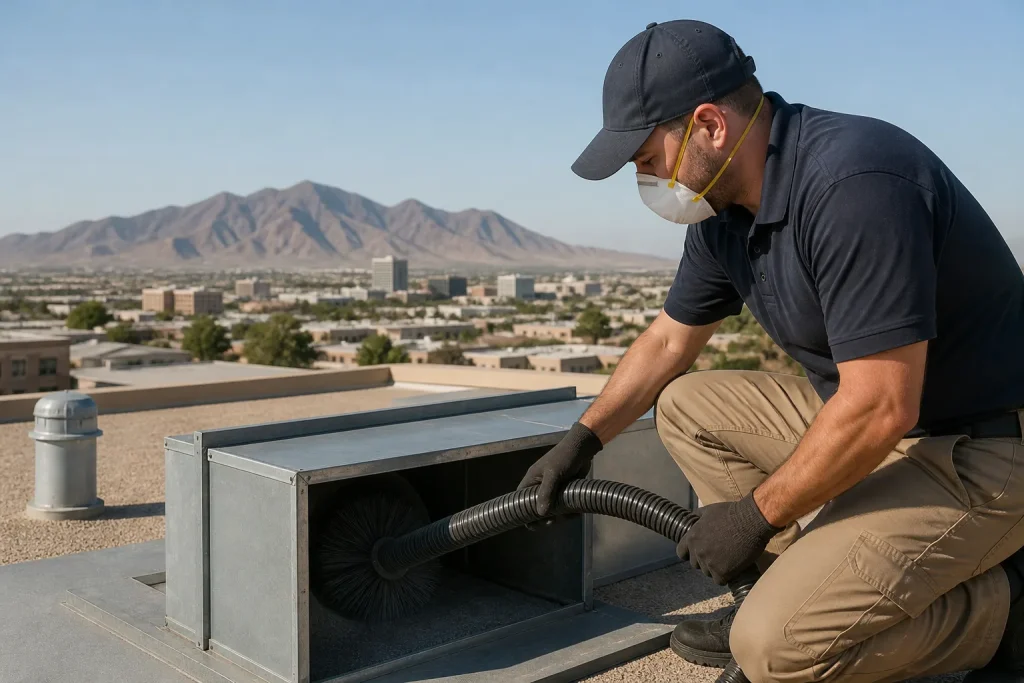
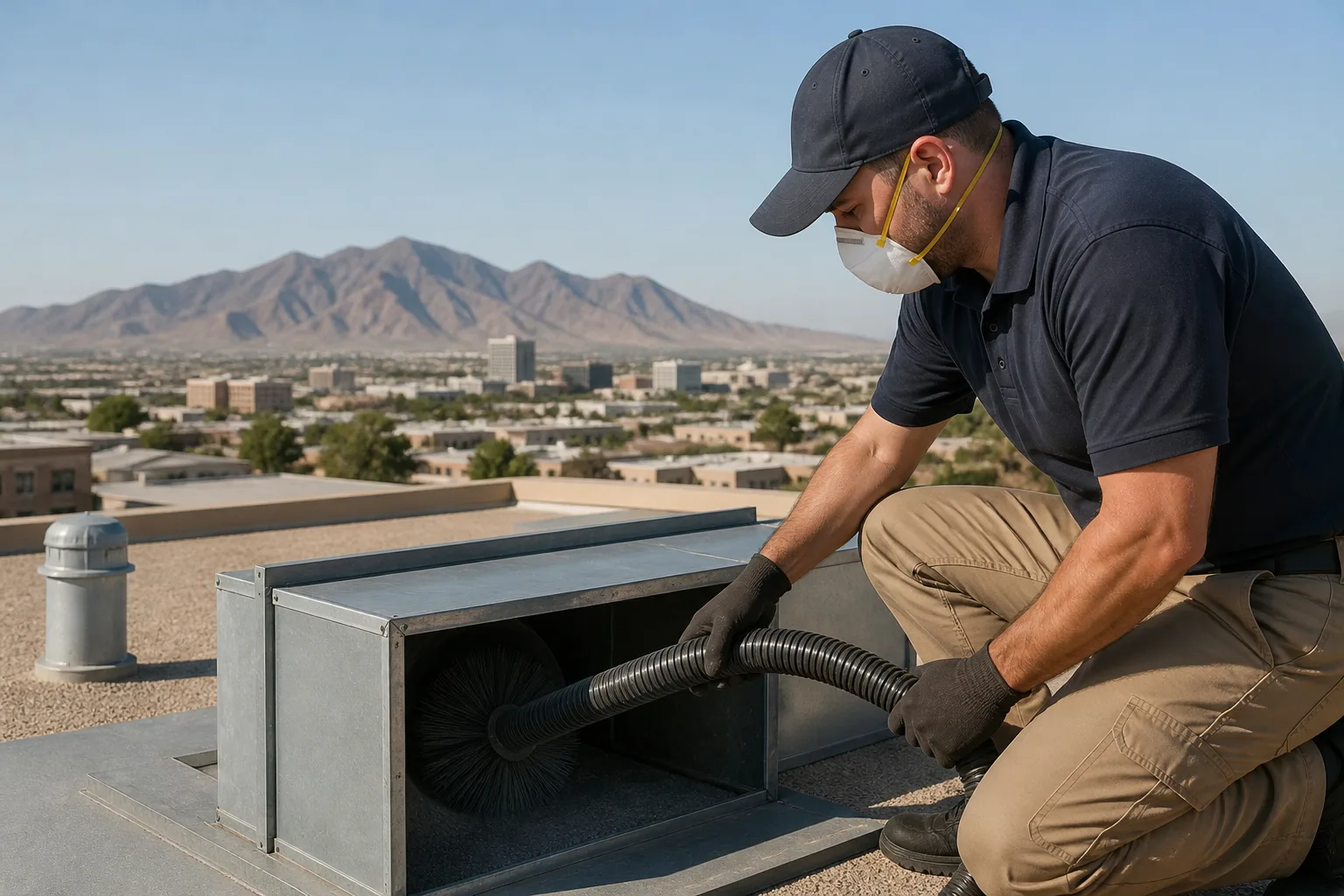
- Rotary brushing. A rotary brush physically scrubs the duct walls, dislodging the adhered dust film that a vacuum alone leaves behind. Manual brushing is slower and less consistent, and vacuum-only “cleaning” is a different service entirely.
We run Rotobrush rotary-brush systems paired with Nikro negative-pressure equipment, and we run Abatement Technologies air-filtration units on-site during the job so dislodged particulates are captured at the source. When we discuss air duct cleaning with a homeowner, equipment is where the conversation starts, because it’s where the outcome is decided.
Does NADCA Membership Actually Mean Anything?
It means something, but not everything. The National Air Duct Cleaners Association sets a professional standard for the trade, and a company that belongs is at least signaling that it knows a standard exists. Membership is a useful first filter. It is not a guarantee of a thorough job.
Two things are true at once. Some NADCA members still cut corners on a busy week, and some excellent operators never joined or let their membership lapse. So treat the certification as a signal to investigate further, not a finish line. What you’re really looking for is whether the company’s stated method matches the standard they claim to follow.
Ask directly: “Walk me through what happens during a cleaning.” Listen for access points, negative pressure, brushing, and containment. If the answer is vague or jumps straight to price, membership or not, you’ve learned what you needed to know. In our experience around El Paso, the companies that volunteer process detail before you ask are the ones that deliver it on the day.
What Does a Legitimate Pre-Job Inspection Look Like?
A legitimate inspection happens before any equipment comes off the truck, and it produces a written scope of work. That sequence protects you. If the first thing a crew does is unload and start working, there’s no agreed definition of what “done” means, and no way to hold anyone to it.
Here’s what a proper inspection covers:
- Access point identification. Where will the crew connect, how many access points does the system need, and will any new ones be cut and sealed afterward?
- Register count. The number of supply and return registers sets the scope. A whole-system price should reflect the actual count, and it shouldn’t be quoted per vent on the day.
- Duct material assessment. Sheet metal, flex duct, and ductboard each need different handling. A technician who doesn’t check before starting can damage flex runs.
- Written scope of work. What’s included, what isn’t, and one flat price for the system, agreed in writing before work starts.
During the inspection, a specialist is also looking for problems cleaning alone won’t fix: disconnected joints, crushed flex runs, torn sections, mold growth on ductboard. We repair what we find, which is why we offer air duct repair as a standalone service rather than leaving the sealing and reconnecting to someone else.
Why Does Specialist vs. Generalist Matter So Much in El Paso?
It’s the most important differentiator on this list. An HVAC company that offers duct cleaning as a revenue add-on is structurally different from a company whose crew and capital investment are dedicated to indoor air quality. The HVAC company’s core business is installing and repairing equipment. Duct cleaning is a line item between service calls, often done with lighter equipment by technicians whose training centers on refrigerant and airflow, not containment and extraction.
A dedicated specialist buys the negative-pressure unit, the rotary-brush system, and the air-filtration equipment first, because it’s the whole job. That shapes everything downstream: the crew’s training, how long they allocate per home, and whether they document their work.
In El Paso, this distinction shows up in the details. Desert dust loads ducts differently than humid climates do, and homes here often run systems for long stretches. A specialist knows what that dust profile looks like inside a return plenum and adjusts the brushing and containment accordingly. A generalist is applying the same checklist they use everywhere. When you search for the best air duct cleaning company in El Paso, filter for specialists first, then run everything else through the tests above.
When Should You Call a Pro Instead of Waiting?
Call a professional when you notice symptoms that point to ductwork rather than a filter. Visible dust streaking from registers, a musty smell when the system kicks on, allergy symptoms that ease when you leave the house, or a dryer that takes two cycles to finish a load are all signals worth a diagnosis. Duct cleaning isn’t a maintenance checkbox; it’s a response to a condition.
Some of this work is genuinely dangerous to attempt yourself. If you suspect damaged ductwork behind a wall, or you’re considering opening a panel near electrical components, stop there. Trained professionals have the containment equipment and the training to work safely inside a forced-air system. Our technicians have up to 10 years of experience with exactly this kind of work.
Related services in El Paso: the same appointment covers dryer vent cleaning, which we treat as a fire-safety service rather than a minor upsell. Lint-impacted vents are a leading cause of residential fires, and we address the full vent run. If you want the complete picture of what we handle around El Paso, that’s the short version: cleaning, dryer vents, and repair.
What Should I Check After the Job Is Done?
Verify the work before you pay, and use a checklist rather than a feeling. A professional job produces documentation. Here are the non-negotiable deliverables:
- Before-and-after photos at multiple access points. Not one glamour shot of a clean register, but photos of the duct interior at each point they worked.
- All registers reseated and sealed. Every grille should sit flush, and any new access points should be sealed and finished.
- No debris at grille faces or on floors. Containment means nothing leaves the system except through the vacuum.
- A written summary of what was found. Condition of the ductwork, any damage identified, and what was repaired or recommended.
One more thing, and this is where a little skepticism pays off. If a company can’t produce photos of your ducts, the work may not have happened the way it was described. Ask upfront whether photos are included, and get it in writing. A specialist will say yes without hesitation.
The Bottom Line
Choosing the right air duct cleaning company in El Paso comes down to vetting mechanics, not marketing. Ask about the negative-pressure unit and its CFM rating. Ask whether the brushing is rotary. Confirm the company is a dedicated indoor-air-quality specialist rather than an HVAC generalist adding a line item. Insist on a pre-job inspection and a written scope of work, and hold the crew to photo documentation when they finish.
We connect homeowners and property managers with independent local professionals who do exactly this work, and we’re glad to answer the equipment questions before you book anything. We stock and service products from Honeywell and Aprilaire, so if filtration upgrades come up during your inspection, our technicians can speak to them credibly.
If you’re in El Paso and need help, Duct Cleaning El Paso offers free estimates. Call (866) 942-6158. We answer 24/7. Fast dispatch from 7am to 7pm, Sunday through Friday.
Frequently Asked Questions
It depends on your system’s register count, duct material, and condition, which is why a legitimate company quotes one flat price per system after an inspection rather than a per-vent rate over the phone. Be wary of a very low teaser price; it often turns into a far larger invoice once the technician is on site. Call (866) 942-6158 for an exact quote. Estimates are free.
Cheap quotes usually reflect lighter equipment and a shorter process: a vacuum-only pass with no rotary brushing and no negative pressure, which stirs dust rather than extracting it. The price is lower because less work is being done. Ask what equipment they use and how long the job takes, and the gap explains itself. Call (866) 942-6158 if you’d like to compare a written scope.
You’ll know because you’ll have before-and-after photos at multiple access points, sealed registers, and a written summary of what was found. Those are standard deliverables from a professional job, not extras. Request them before you book, not after. Call (866) 942-6158 to ask what documentation is included.
There’s no fixed schedule that fits every home. Dust load, pets, recent renovation, and visible buildup at the registers all matter more than a calendar. In a dusty climate like El Paso’s, an inspection every few years tells you more than a rule of thumb. Call (866) 942-6158 and we’ll help you decide whether it’s time.
Written by the team at Duct Cleaning El Paso.
Need Air Duct Cleaning Help?
Call Duct Cleaning El Paso - licensed & insured, here with fast help in El Paso.
(866) 942-6158